
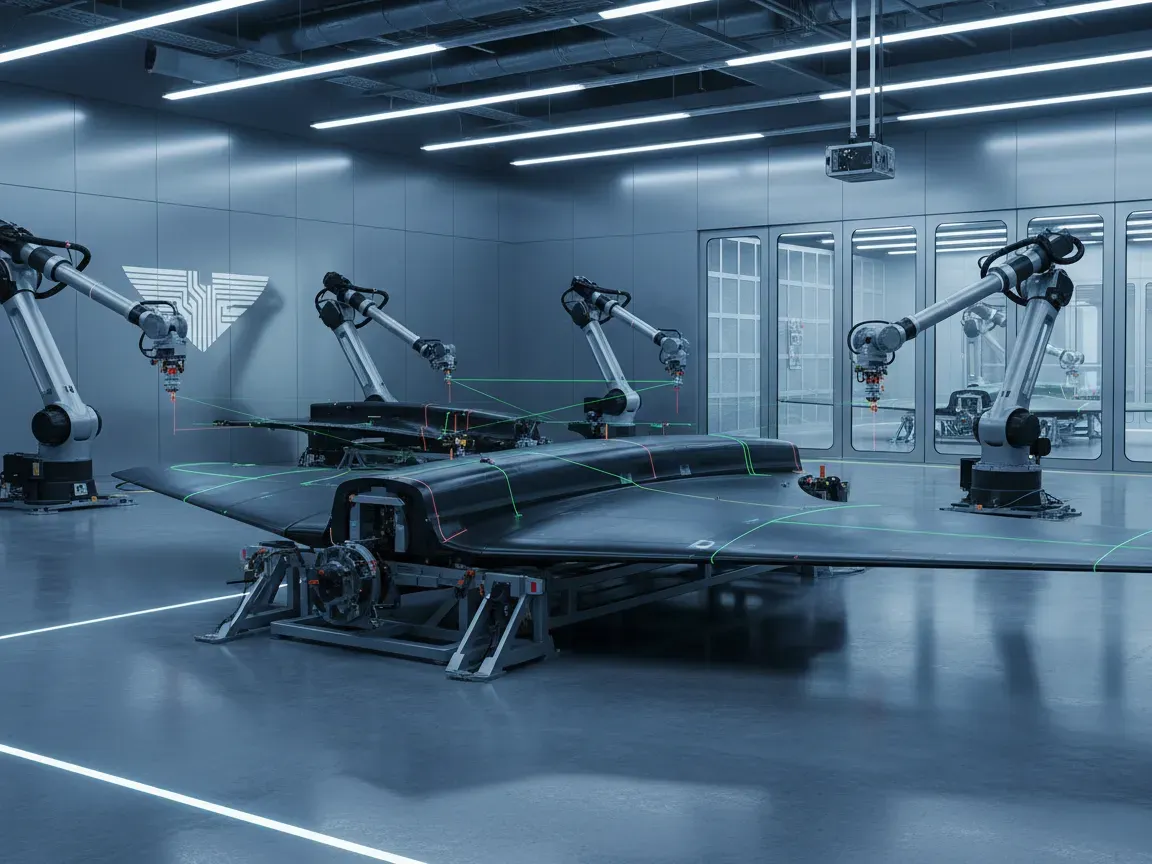
The United States Air Force and Northrop Grumman have broken ground on a monumental $4.5 billion expansion program at Air Force Plant 42 in Palmdale, California. This massive financial commitment marks a pivotal transition from initial development to long-term industrial scale for America’s newest strategic asset, the B-21 Raider. As global security dynamics shift toward near-peer competition, securing a resilient and high-capacity manufacturing base has become an urgent operational imperative for the Pentagon.
The investment reflects a deliberate approach to industrial defense strategy. Rather than treating production facilities as an afterthought, the Air Force is treating the manufacturing floor as a vital component of national deterrence. By securing the physical and digital infrastructure required to build modern stealth bombers, the Department of Defense aims to eliminate production bottlenecks before full-rate manufacturing begins.
Inside the $4.5B Palmdale Expansion
The physical footprint of the expansion centers on Plant 42, a legendary aerospace center that has served as the birthplace for some of the most sophisticated military aircraft in history. The $4.5 billion capital infusion targets both physical infrastructure and advanced manufacturing technology.
Key components of this modernization effort include:
- Construction of specialized assembly bays engineered with tight environmental controls for stealth coating applications.
- Advanced testing chambers designed to evaluate sensitive radar-absorbent materials under simulated operational stresses.
- Secure, high-clearance digital integration labs that connect software engineers directly to airframe testing rigs.
- Modernized logistics hubs capable of managing thousands of serialized parts flowing in from suppliers across the country.
Beyond brick and mortar, the project prioritizes digital thread architecture. Northrop Grumman is building out facility-wide digital infrastructure that links computerized design models directly to robotic tooling and automated inspection systems. This reduces assembly tolerances to microscopic levels, ensuring that every aircraft rolling off the line meets strict low-observable standards without requiring labor-intensive manual adjustments.
How the Upgrade Accelerates B-21 Raider Production?
Speed to ramp is the driving metric behind this major capital deployment. The B-21 Raider entered low-rate initial production after completing critical flight test milestones, but moving from prototype testing to operational fleet fielding requires a massive leap in manufacturing cadence.
The new facilities directly address historical defense acquisition pitfalls. Traditional military aerospace programs often suffered from production delays because early assembly lines lacked the floor space and automation needed to build multiple airframes concurrently. By scaling the Palmdale footprint now, Northrop Grumman can run parallel assembly lines rather than sequential ones.
Digital design tools also play a decisive role in speeding up timelines. Because the B-21 was designed using digital twins, the tooling within the new buildings is configured to mirror virtual assembly lines. Technicians use augmented reality overlays to inspect wiring harnesses, structural fasteners, and composite materials in real time. This automated verification eliminates weeks of traditional quality assurance checks, moving completed airframes to testing squadrons much faster.
Economic Winds: Jobs and Supply Chain Growth in California
While the primary mission of the expansion is national security, the local and regional economic effects across Southern California are profound. The Antelope Valley has long maintained a specialized aerospace workforce, and this project locks in sustained economic momentum for decades to come.
The influx of capital touches several layers of the regional economy:
- Creation of thousands of high-wage jobs in advanced composite manufacturing, systems engineering, and robotics integration.
- Significant growth for local commercial construction firms, specialized equipment vendors, and industrial service providers.
- Expanded recruitment pipelines with regional universities, technical schools, and community colleges to train the next generation of technicians.
- Secondary economic stimulus for local housing, retail, and municipal infrastructure across the Palmdale and Lancaster communities.
Furthermore, the expansion stabilizes an extensive tier-one and tier-two aerospace supply chain. Thousands of small and mid-sized machine shops, electronics fabricators, and raw-material suppliers across California and the wider nation rely on steady production quotas. A long-term $4.5 billion commitment provides these suppliers with the predictability they need to invest in their own internal tooling and personnel.
Strategic Defense Priorities Driving Air Force Modernization
The urgency behind the Palmdale expansion is rooted in shifting global military balances. For two decades, American air power operated primarily in uncontested airspace across the Middle East. Today, the strategic focus has returned to high-end deterrence against sophisticated adversary integrated air defense systems.
The B-21 Raider is engineered to penetrate modern anti-access and area-denial environments that would pose extreme hazards to legacy bombers like the B-1 Lancer or B-52 Stratofortress. With advanced radar systems and long-range surface-to-air missiles proliferating rapidly, deep-penetration stealth capabilities are critical for holding heavily fortified targets at risk.
Reliable deterrence depends not just on having advanced technology, but on possessing it in credible numbers. A small handful of stealth aircraft cannot sustain a protracted conventional conflict across expansive operational theaters. By funding this expansion, defense planners are ensuring the Air Force can field a fleet of at least 100 operational Raiders, providing combatant commanders with continuous long-range strike options.
What This Massive Investment Means for the Future of Aerospace Defense?
The joint effort between Northrop Grumman and the Air Force establishes a modern template for public-private defense partnerships. Instead of relying on slow, incremental upgrades to aging facilities, the Pentagon is making proactive investments in modular, software-defined production hubs capable of adapting to future requirements.
This investment also sets the standard for how the military will manage lifecycle maintenance and future modifications. The facilities built today are designed with open-architecture principles, meaning future sensor upgrades, autonomous teaming capabilities, and electronic warfare suites can be integrated directly on the Palmdale line without gutting the facility. The capital deployed today is structured to support the aircraft through decades of evolving threats.
Establishing the Industrial Foundation for Long-Term Air Dominance
The expansion at Palmdale demonstrates that superior aircraft design is only half the battle in modern military aviation; the ability to build and sustain those designs at scale is what truly secures defense objectives. By deploying $4.5 billion into automated tooling, digital assembly, and specialized workforce training, the Air Force is laying a permanent foundation for next-generation aerial warfare.
For defense analysts, industry observers, and taxpayers, this initiative offers clear evidence of a fundamental shift in defense acquisition. The focus has moved past experimental prototypes toward industrial resilience and manufacturing agility. As geopolitical pressures mount, the facility will serve as the engine room for American long-range strike capability, ensuring that technological dominance on paper translates directly into operational readiness in the skies.